Tone Farm
IN DEVELOPMENT A WARREN LABS PRODUCT

Tone Farm

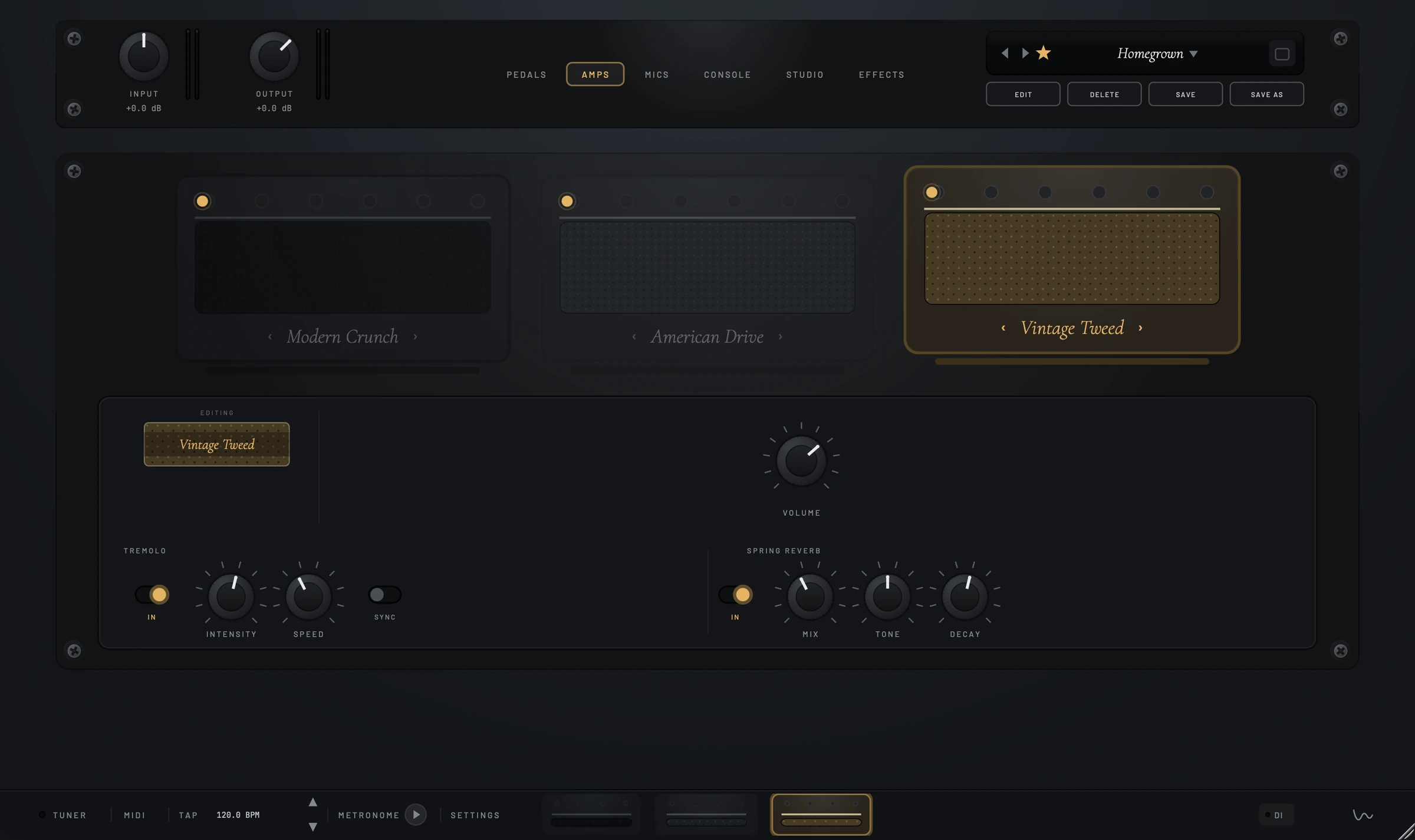
Three amps run at once. Each one has its own cab, its own two mics, and its own channel strip.

A guitar amp and effects plugin for macOS. Every picture on this page is a screenshot of it running. It isn't finished: the sound is still being voiced by ear. The page below says which parts are which.
Follow the build What's done
The Tone Farm plugin's Amps page: three amp heads side by side — Modern Crunch, American Drive and Vintage Tweed — above a shared control panel with volume, tremolo and spring reverb.
The Amps page. Three heads, always blending. This is what opens when you load the plugin.
THE RIG

Three amps. None of them switch off.

There's no channel switch and no solo button. The three amps always blend. That's the point: you build one sound out of three heads, the way you would if you had them in a room and a hand on the faders.

Six voicings to choose from: American Clean, American Combo, American Drive, Modern Crunch, Vintage Tweed, Boutique Chime. Any of them in any slot. Run three of the same one if that's what the song wants.

WHAT EACH AMP OWNS

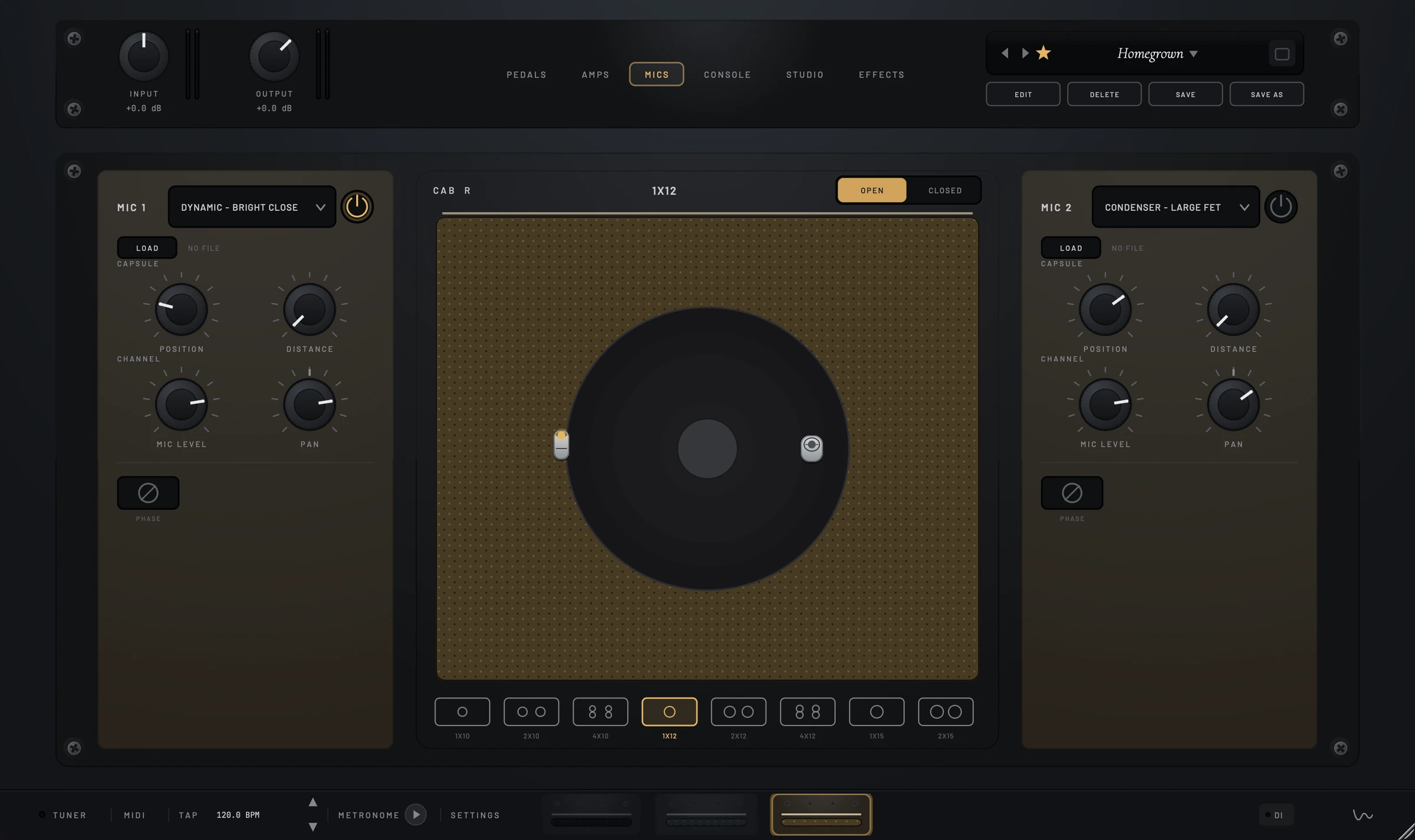
Its own cab. Eight configurations, 1×10 up to 2×15, open or closed back.

Its own two mics. Eleven models across dynamics, condensers and ribbons, each with position, distance, level, pan and phase.

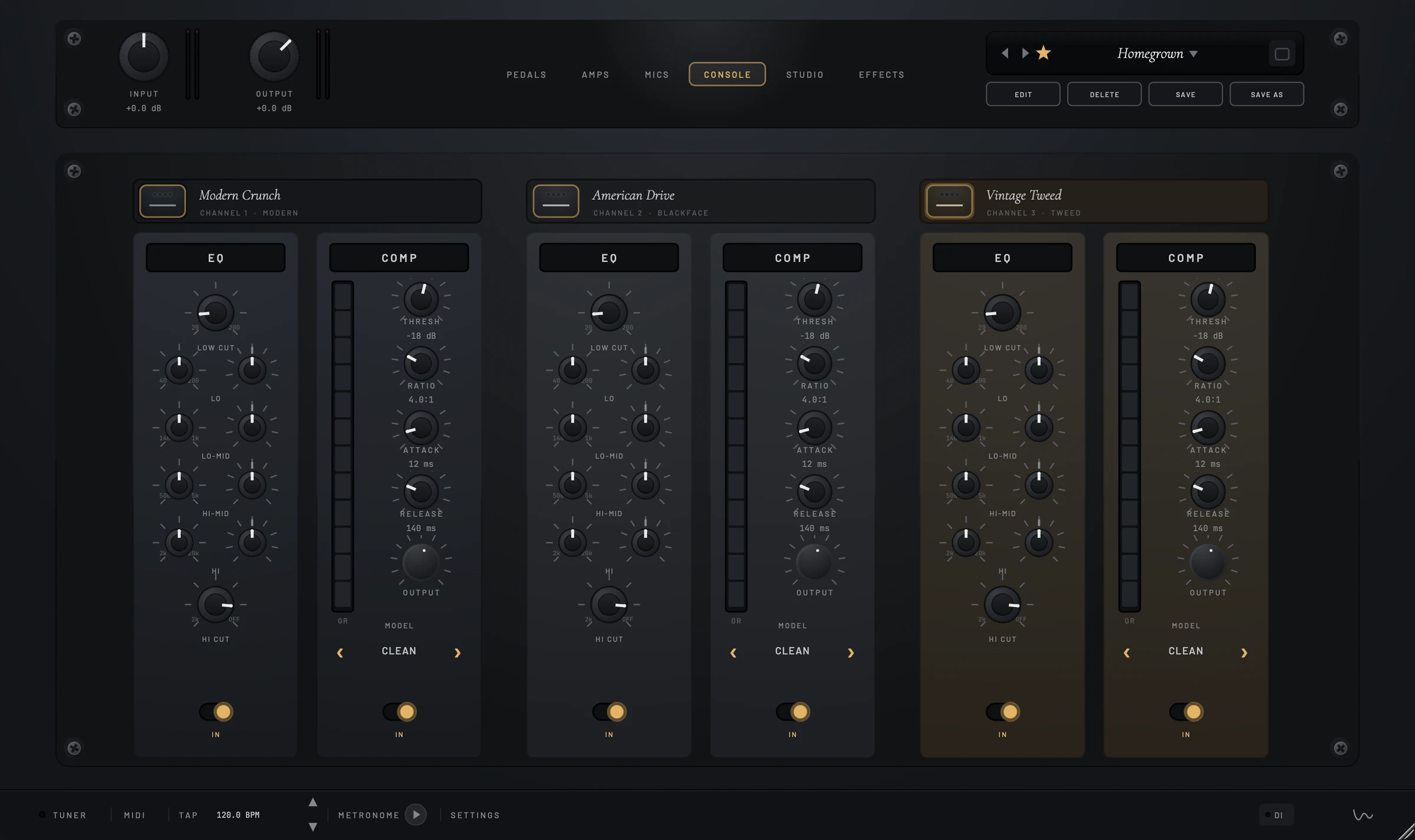
Its own channel strip. Six-band EQ and a compressor, with Clean, FET and Opto models.

Its own tremolo and spring reverb, sitting before the cab so the wobble gets miked the way it would on a real amp.

Its own send into the room all three share.

Three amps, two mics each. Six microphones open at once.

There's no pan knob on the amps. The mic pans place them, because that's the control that does the job.

The Console page: three vertical channel strips, one per amp, each labelled with its amp name and carrying a six-band EQ and a compressor with gain-reduction metering.
The Console page. Three amps, three channel strips. The EQ and the compressor belong to the amp, not to the plugin.
The Mics page: a large speaker cone in the centre with two draggable microphone markers on it, flanked by a control strip for each mic, and a row of cabinet configurations along the bottom.
The Mics page. Two mics on the cone, dragged where you want them. Underneath: the eight cabs, open back or closed.
THE ROOMS

Sanctuary and Old School.

Two rooms inside Free River Studios, a working studio in a former school building in Livingston, Montana: the auditorium and the stairwell. They're the reason the plugin has the shape it has, and they're the two rooms it's named for.

Sanctuary
THE AUDITORIUM
● ENGAGED
LUSH LONG TAIL WARM LOW-MID

The big one. Long, lush and enveloping, with the pre-delay range to put real distance behind the amp. It's the sound of air in a large wooden room, and it's what the plugin loads by default.

Old School
THE STAIRWELL
BRIGHT PUNCHY HARD REFLECTIONS

Small, bright and comby: drums at the bottom of the stairs. It's the only room with 6 dB of drive on the tail and a compressor of its own on the wet return, which is what makes it snap back at you instead of decaying politely.

WHERE THEY ACTUALLY STAND

Both rooms are algorithmic today. Neither one has been captured.

What ships right now is a feedback-delay-network reverb per room, voiced by ear against the memory of the place. It sounds good. It isn't the room. Inside the plugin the convolution path is already wired up and sitting empty, waiting on the measurement.

When the auditorium and the stairwell get measured, each room swaps to an impulse response of the actual space. In the code that's a one-line change, because it was built for it from the start. You'll hear the difference, and this page will say the day it happens.

THE PLACE
FREE RIVER STUDIOS
LIVINGSTON, MT
A FORMER SCHOOL

Jamey Warren spent 25 years in pro audio, first as Grace Design's first employee and later as HeadRoom's CEO. Then he built Free River Studios in an old school building in Livingston, Montana. Sanctuary and Old School are its auditorium and its stairwell: real rooms with real doors, a short walk apart. Getting them into a plugin honestly is the long part of the job, and it's the part still in front of him.

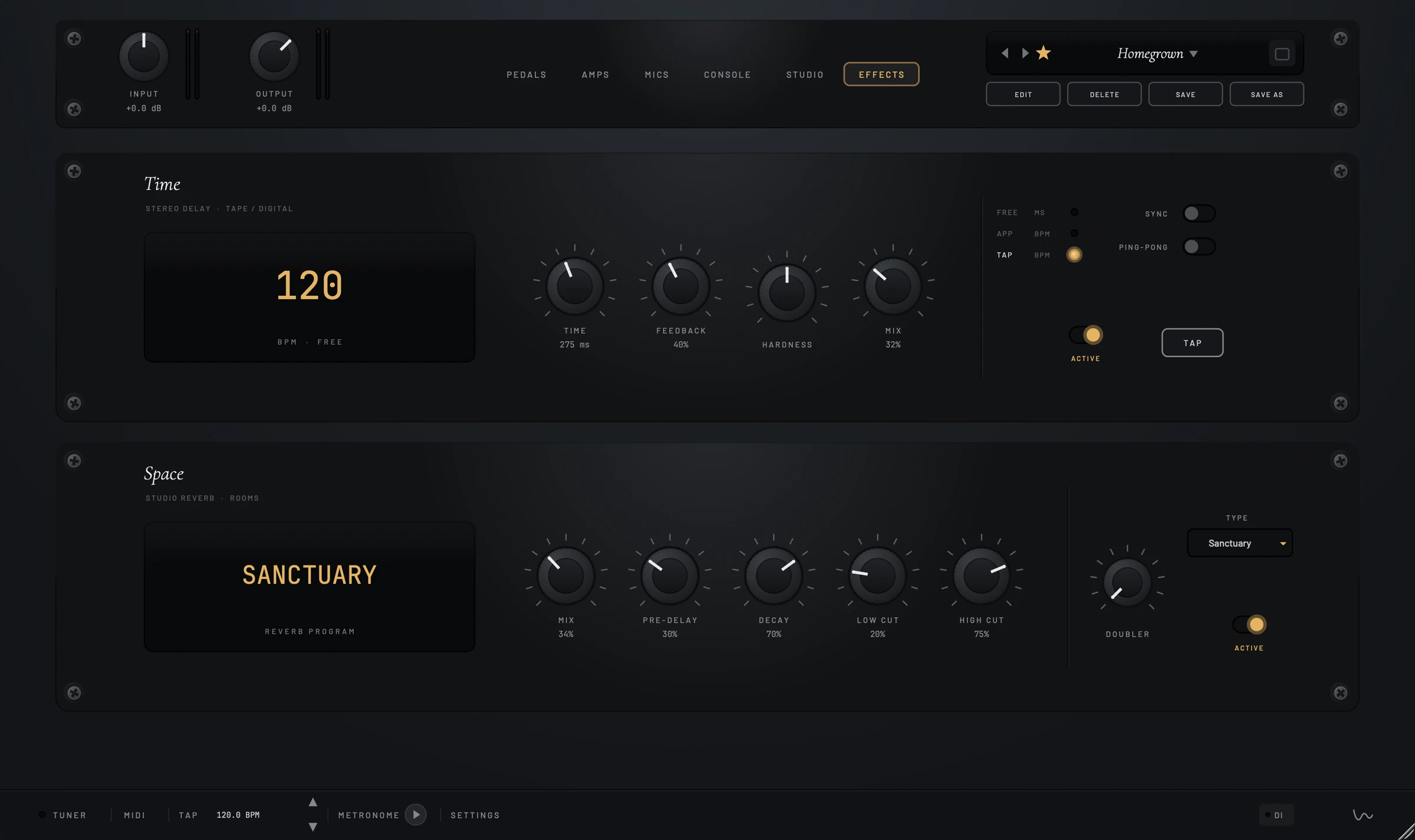
The Effects page: a stereo delay unit showing 120 BPM on its display, above a reverb unit with SANCTUARY loaded as the reverb program and controls for mix, pre-delay, decay, low cut and high cut.
The Effects page with Sanctuary loaded. Six rooms in the slot: Sanctuary, Old School, Hall, Plate, Chamber, Room.
THE CHAIN — SIX PAGES, IN SIGNAL ORDER

Pedals, Amps, Mics, Console, Studio, Effects.

Six pages, laid out in the order the signal travels. The order is fixed, because that's the order it happens in.

01
Pedals

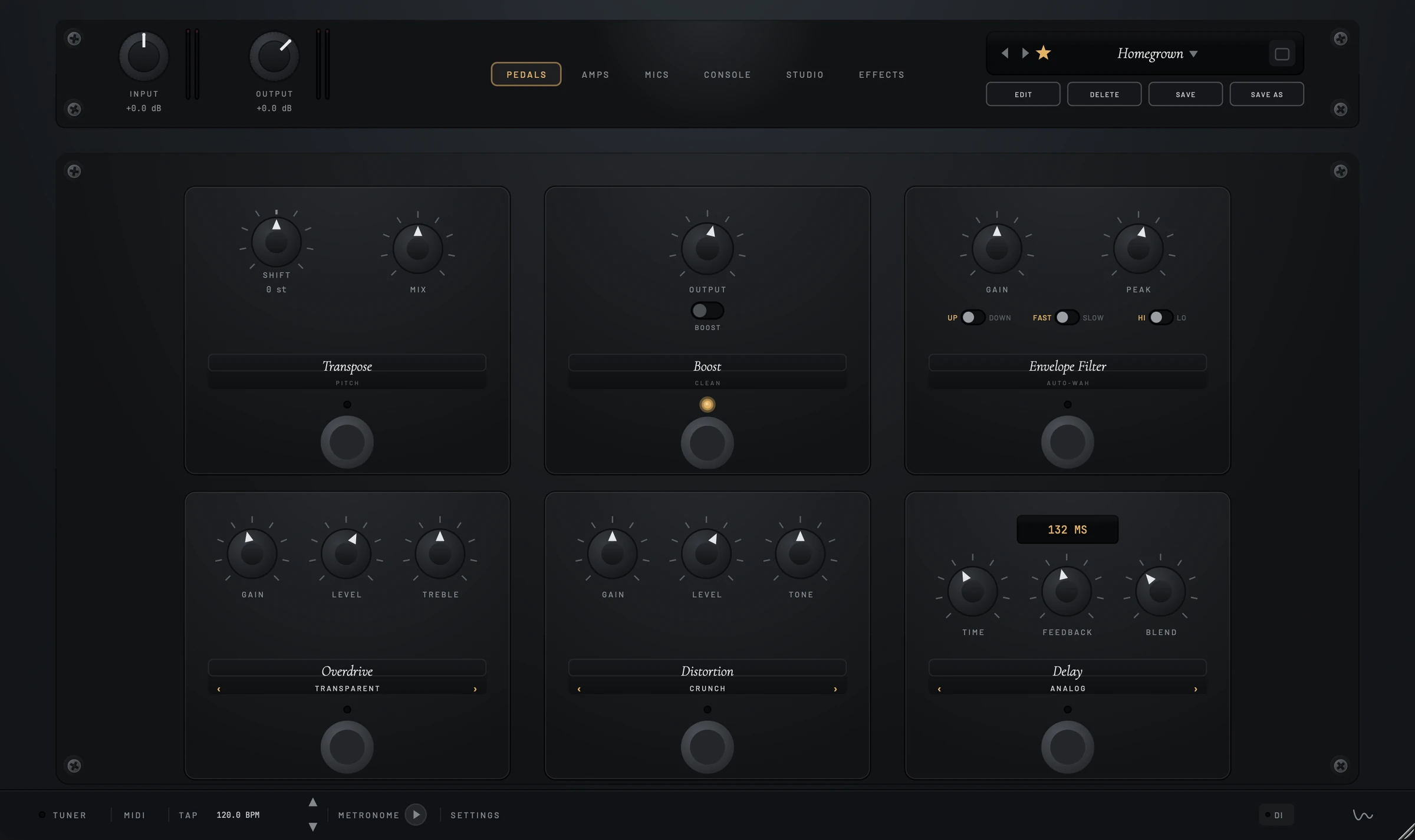
Six on the board: Transpose, Boost, Envelope Filter, Overdrive, Distortion, Delay. The overdrive runs Transparent, Warm or Bright. The distortion does Crunch, Punch or Fuzz. The delay is Analog, Tape or Digital. Mono, out in front, like a board on the floor.

02
Amps

The three heads and their tone stacks, plus the tremolo and spring tank each one carries. Six voicings, any slot, always blending.

03
Mics

A cab per amp and two mics on it. Where you put them is most of the sound, so this page is mostly a big speaker and two things to drag around on it.

04
Console

A channel strip per amp. Six-band EQ, and a compressor with an advanced panel when you want the threshold, ratio, attack and release rather than one knob.

05
Studio

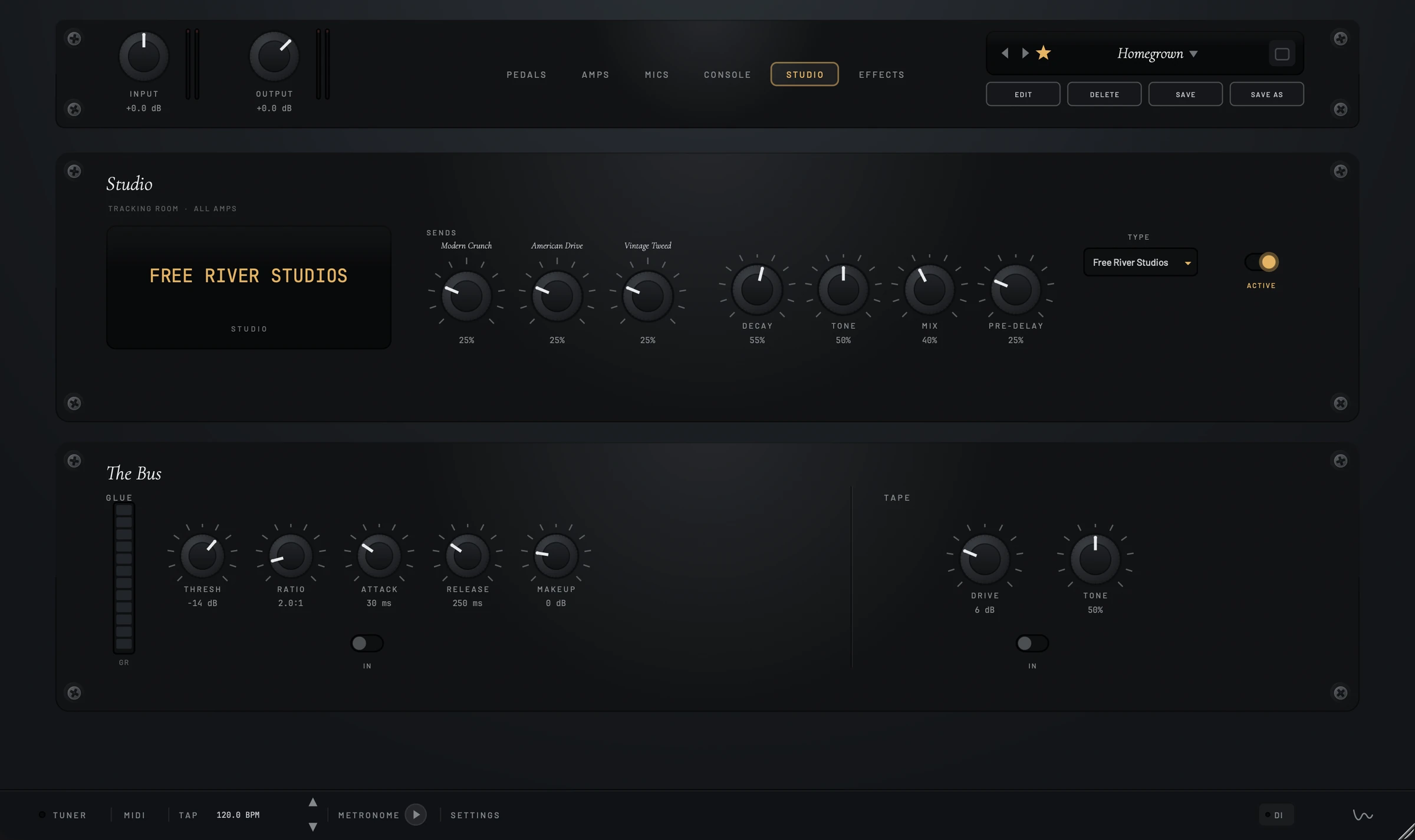
All three amps send into one shared tracking room, then the sum hits a glue compressor and a tape stage. The room it opens on is named for Free River Studios itself, and like the rest of them it's voiced rather than captured. This is the page that stops it sounding like three separate plugins.

06
Effects

Stereo delay, tape or digital, free or locked to the host, with ping-pong if you want it. Then the rooms, and a doubler. Sanctuary and Old School live here.

The Pedals page: six stompboxes on a velcro board in two rows of three — Transpose, Boost, Envelope Filter, Overdrive, Distortion and Delay — each with knobs, a footswitch and a voicing label.
The Pedals page. Six boxes on a board. The delay's display is showing its live time in milliseconds.
The Studio page: a tracking-room unit with Free River Studios loaded, showing a send knob named for each of the three amps, above a bus unit with a glue compressor and a tape stage.
The Studio page. A send per amp into the shared room, then glue and tape across the sum. The room loaded here is named for the studio the whole plugin came out of.
AND THE THINGS YOU'D EXPECT

A chromatic tuner that can mute the output while you use it. A metronome. Tap tempo, and sync to your host's clock. MIDI learn, so a foot controller can work the knobs and change presets. Save your own presets and star the ones you keep coming back to. Drag the corner to resize the whole thing, or run it full screen.

WHAT'S DONE

It runs. Now it has to sound right.

The plugin builds, loads, passes Apple's validation and holds up under a render harness. Every page in the screenshots above is finished and wired to real DSP.

What's left is the slow part: sitting with a guitar and voicing it by ear, one stage at a time, until the defaults are worth trusting. Three reverbs currently default to on at once, which is exactly the kind of thing that pass is for.

IF AND WHEN IT SHIPS

AU · VST3 · STANDALONE
MACOS 11+ · APPLE SILICON AND INTEL
NO PRICE AND NO DATE YET

HONEST STATUS
Three-amp rig, cabs, micsWORKING
Pedals, EQ, compression, delayWORKING
Tuner, metronome, MIDI learnWORKING
AU, VST3 and StandaloneWORKING
Voicing it by earIN PROGRESS
Sanctuary & Old SchoolMODELED
Measured IRs of the real roomsPLANNED
Loading your own cab IRsPLANNED
FOLLOW THE BUILD

Watch it get finished.

Notes from the bench when there's something worth saying: what got built, what got measured, what turned out to be wrong. And the week the rooms finally get captured.

Or read the lab notes at warrenlabs.com →